
Point-of-Care Ultrasound Training for Beginners: A Step-by-Step Guide for New Physicians
Point-of-care ultrasound (POCUS) is becoming an essential skill for physicians who need to assess patients quickly and make informed clinical […]
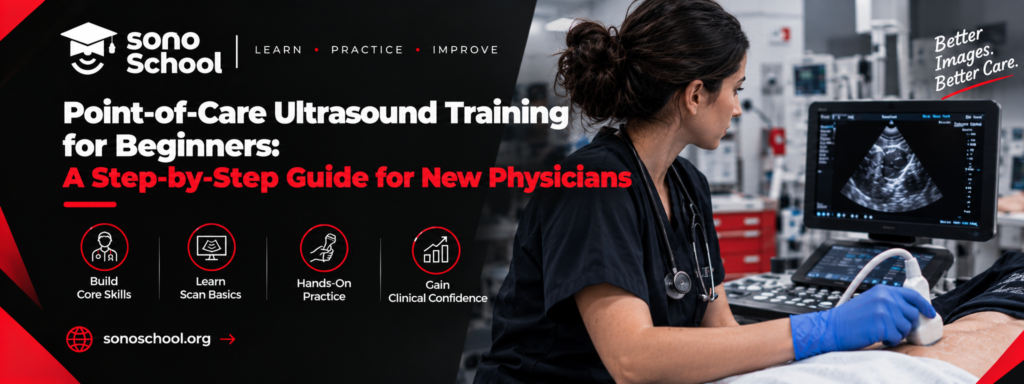
Point-of-care ultrasound (POCUS) is becoming an essential skill for physicians who need to assess patients quickly and make informed clinical decisions. From emergency departments to intensive care units, bedside ultrasound allows clinicians to visualize internal structures in real time and complement their physical examinations.
However, learning to operate an ultrasound machine is only the beginning. Physicians must also understand image acquisition, recognize normal and abnormal findings, interpret results within the clinical context, and know when additional investigations are necessary.
This guide to point of care ultrasound training for beginners explains how new physicians can develop foundational scanning skills, choose the right training program, and build a structured learning plan. Whether you work in emergency medicine, internal medicine, anesthesiology, or critical care, the right approach to POCUS education can help you progress toward safe and effective clinical practice.
What Is Point-of-Care Ultrasound (POCUS)?
Point-of-care ultrasound is an ultrasound examination performed by a trained healthcare professional at or near the patient’s bedside to answer a specific clinical question.
Unlike conventional imaging workflows that may require referral to a separate imaging department, POCUS allows clinicians to obtain targeted images during patient assessment. It can support clinical decisions when used appropriately and interpreted alongside the patient’s history, physical examination, and other investigations.
Common applications include:
- Emergency medicine: Assessing selected causes of shock, abdominal emergencies, and traumatic injuries.
- Critical care: Evaluating cardiac function, lung findings, and selected causes of hemodynamic instability.
- Internal medicine: Supporting the assessment of fluid status, pleural effusions, and selected abdominal conditions.
- Anesthesiology: Supporting vascular access, regional anesthesia, and other ultrasound-guided procedures.
- Musculoskeletal medicine: Examining selected muscles, tendons, joints, and soft tissues.
For new physicians, structured POCUS education provides a foundation for understanding these applications before progressing to more advanced examinations. Reviewing the AIUM point-of-care ultrasound practice parameters can also help clinicians understand professional expectations for appropriate ultrasound practice.
Why Is Point-of-Care Ultrasound Training for Beginners Important?
A structured training program helps physicians move beyond simply producing ultrasound images. Effective learning combines theoretical knowledge, supervised scanning, image interpretation, and clinical reasoning.
There are several important benefits to starting with a beginner-friendly POCUS course.
1. Develop practical scanning skills
Learners become familiar with probe selection, probe orientation, scanning planes, and image optimization. These fundamentals make it easier to acquire useful images consistently.
2. Improve bedside assessment
POCUS can help physicians investigate focused clinical questions in real time, potentially supporting faster and more targeted decision-making.
3. Build confidence through supervised practice
Hands-on training allows beginners to receive feedback, correct technical errors, and understand why certain images are difficult to obtain.
4. Establish a foundation for advanced training
Once learners understand basic principles, they can progress to focused cardiac ultrasound, lung ultrasound, vascular access, and specialty-specific applications.
Importantly, completing a short course does not automatically establish independent clinical competence. Physicians should follow applicable professional requirements, institutional policies, and supervised competency assessments.
If you are beginning your ultrasound journey, consider exploring SonoSchool’s Basic POCUS Two Days Course to learn more about structured foundational training. The course curriculum and practical requirements should be reviewed before enrollment to ensure they match your learning objectives.
Point-of-Care Ultrasound Training for Beginners: A Step-by-Step Learning Path
The most effective way to learn POCUS is to progress from basic concepts to focused examinations, followed by supervised clinical integration.
Step 1: Learn the Fundamentals of Ultrasound
Before scanning patients, understand how ultrasound images are generated and what they represent.
Start by studying:
- Basic ultrasound physics and sound-wave behavior.
- Transducer types and their clinical applications.
- Probe orientation and image markers.
- Depth, gain, and image optimization.
- Echogenicity and common ultrasound artifacts.
- Patient safety and appropriate equipment handling.
You should also learn how to identify image quality problems and distinguish a technically inadequate examination from a meaningful negative finding.
Beginner tip: Choose an introductory POCUS course that explains the underlying principles rather than focusing exclusively on memorizing images. A strong foundation makes advanced scanning easier to understand.
For additional guidance, review the AIUM ultrasound training guidelines and discuss your learning needs with a qualified instructor.
Step 2: Understand the Ultrasound Machine and Probes
The next step is learning how to operate the machine efficiently.
Common transducers include:
- Curvilinear probe: Commonly used for abdominal imaging and selected deeper structures.
- Linear probe: Useful for superficial structures, vascular access, and musculoskeletal examinations.
- Phased-array probe: Frequently used for cardiac imaging and selected examinations where access between the ribs is important.
Learn how to select the appropriate probe, adjust depth and gain, position the image correctly, and save representative images.
These skills may seem simple, but they directly influence image quality. A poorly optimized image can make anatomical structures difficult to identify and increase the risk of misinterpretation.
Step 3: Start with Basic POCUS Examinations
Beginners should start with a limited number of examinations that match their specialty and clinical responsibilities.
| Examination | Main learning objective |
| Lung ultrasound | Recognize pleural lines, lung sliding, and common artifacts |
| Focused cardiac ultrasound | Identify basic cardiac views and assess selected features of cardiac function |
| Abdominal ultrasound | Recognize major anatomical landmarks and understand focused examination protocols |
| Vascular ultrasound | Identify vessels and understand their appearance before supervised procedural training |
| Bladder ultrasound | Visualize the bladder and understand basic volume assessment |
You do not need to master every application simultaneously. Select one examination, learn its indications and limitations, and practice obtaining the required views before expanding your scope.
For example, a physician working in an intensive care unit may prioritize lung and cardiac ultrasound, while an emergency medicine trainee may begin with focused examinations relevant to trauma and undifferentiated shock.
If you are new to bedside ultrasound, explore the Basic POCUS Two Days Course at SonoSchool to review the available training pathway and determine whether it aligns with your specialty and experience.
Step 4: Practice Image Acquisition Under Supervision
Watching demonstrations is useful, but practical scanning is essential.
During supervised sessions, focus on three core skills:
- Probe positioning: Place and move the probe to obtain the intended anatomical view.
- Image optimization: Adjust the machine settings to improve visualization without losing important information.
- Image recognition: Identify anatomical structures and understand whether the acquired view is adequate for the clinical question.
Ask an experienced instructor to review your images and explain technical mistakes. Practice on appropriate training models or volunteers when available, following consent, supervision, and institutional requirements.
A useful approach is to maintain a learning log containing the examination type, views attempted, image-quality feedback, and areas requiring further practice.
Step 5: Learn to Interpret Images in Clinical Context
Obtaining a recognizable image does not automatically mean that you can interpret it correctly.
Develop a systematic approach to interpretation:
- Identify the structures visible in the image.
- Determine whether the image meets the examination’s quality requirements.
- Recognize relevant normal findings and common abnormalities.
- Consider alternative explanations and possible artifacts.
- Correlate findings with symptoms, examination results, and other investigations.
- Identify when further imaging, specialist review, or urgent escalation is required.
For example, lung ultrasound findings should be interpreted alongside the patient’s symptoms, oxygenation, physical examination, and relevant clinical history. A single ultrasound sign should not be treated as definitive proof of a diagnosis when other explanations remain possible.
Key principle: POCUS complements clinical assessment; it does not replace clinical reasoning or comprehensive imaging when indicated.
Step 6: Document Findings and Recognize Limitations
Professional POCUS practice includes more than scanning and interpretation. Physicians should learn to document the indication, examination performed, relevant findings, image quality, limitations, and clinical interpretation according to local policies.
You should also recognize situations in which an examination is incomplete or inconclusive. Limited visualization, patient positioning, body habitus, and technical factors can affect image quality.
If the examination cannot answer the clinical question reliably, arrange appropriate additional assessment rather than assuming that an inconclusive scan is normal.
Step 7: Progress Toward Competency-Based Training
Once you have learned the fundamentals, develop a structured plan for continued improvement.
Your next steps should include:
- Completing additional supervised scanning sessions.
- Reviewing saved images and receiving expert feedback.
- Studying relevant clinical cases.
- Tracking your progress against defined learning objectives.
- Repeating examinations until you can demonstrate the required skills.
- Following specialty-specific requirements for clinical practice and credentialing.
Competency should be assessed through demonstrated performance, not simply the number of videos watched or lessons completed.
Physicians seeking a longer-term educational pathway can explore the POCUS Fellowship in Acute Care Settings at SonoSchool. Review the program structure, eligibility criteria, duration, and assessment requirements to determine whether it matches your professional goals.
For clinicians who have already developed foundational skills, SonoSchool’s Advanced POCUS Two Days Course may also be worth exploring as a potential next step. Confirm the prerequisites before enrolling.
How to Choose the Best POCUS Course for Beginners
Selecting the right course can make a significant difference in how efficiently you develop practical skills.
Before you enroll in a point-of-care ultrasound course, compare programs using the following criteria.
Beginner-friendly curriculum: The course should explain ultrasound physics, machine operation, probe handling, and basic image interpretation without assuming previous scanning experience.
Hands-on ultrasound training: Look for supervised practice, live demonstrations, or clearly structured practical sessions. Online lessons are valuable, but video instruction alone cannot establish hands-on competence.
Qualified instructors: Choose educators with relevant clinical experience and expertise in ultrasound education.
Case-based learning: Clinical examples help connect ultrasound findings with real patient scenarios and demonstrate the limitations of individual signs.
Feedback and assessment: A quality program should explain how learners receive feedback and demonstrate progress toward defined competencies.
Flexible learning options: Online POCUS courses can help busy physicians study theoretical concepts at their own pace. If practical scanning is required, check whether the provider offers supervised sessions or suitable local training opportunities.
Transparent course details: Review the syllabus, learning outcomes, instructor qualifications, practical requirements, fees, and certificate conditions before registering.
When evaluating educational programs, consult the AIUM ultrasound training guidelines and compare them with each course’s learning objectives and assessment methods.
If your professional interests include musculoskeletal applications, you can also explore SonoSchool’s Musculoskeletal Ultrasound Course to determine whether it fits your specialty and future training plans.
How Long Does It Take to Learn POCUS?
The time required depends on the examination type, your previous experience, the quality of instruction, and how consistently you practice.
You may learn basic machine operation and recognize common anatomical landmarks during an introductory course. Developing reliable image acquisition and interpretation skills generally requires continued supervised practice and assessment.
Advanced applications, such as comprehensive cardiac assessment or complex ultrasound-guided procedures, require additional specialty-specific education.
Instead of focusing only on completing a course quickly, establish measurable goals: obtaining adequate views, recognizing relevant anatomy, identifying limitations, and interpreting findings appropriately within your scope of practice.
Frequently Asked Questions About Point-of-Care Ultrasound Training for Beginners
1. Can beginners learn POCUS without previous ultrasound experience?
Yes. Many introductory POCUS programs are designed for healthcare professionals with little or no previous scanning experience. Beginners should start with basic ultrasound principles, machine operation, and focused examinations before progressing to more complex applications.
2. What is the best point-of-care ultrasound course for new physicians?
The best course is one that matches your specialty, experience, and learning objectives. Look for a structured curriculum, qualified instructors, practical scanning opportunities, case-based learning, and competency assessment. Compare course content and requirements before choosing a program.
3. Is online POCUS training enough to become competent?
Online training can teach theoretical concepts, probe orientation, image recognition, and examination protocols. However, physicians also need appropriate practical experience, feedback, and assessment to develop scanning competence. Online completion alone should not be assumed to authorize independent clinical practice.
4. Which POCUS examination should beginners learn first?
Start with an examination relevant to your clinical setting and supported by your training program. Lung ultrasound, basic focused cardiac ultrasound, and selected abdominal examinations are common starting points. Your instructor can help prioritize applications based on your specialty and supervised learning opportunities.
5. Do I need a certificate to perform POCUS?
Requirements vary by country, institution, specialty, and intended application. Completing a course certificate does not necessarily equal professional credentialing or demonstrated clinical competence. Check your local regulations, institutional policies, and specialty-specific training requirements before using POCUS independently.
6. How can I improve my POCUS skills after completing a course?
Continue supervised scanning, review your images with experienced instructors, study clinical cases, and document your progress. Seek regular feedback and reassessment, and expand into advanced applications only when your foundational skills and clinical training support that progression.
7. Where can I find structured POCUS training for physicians?
Physicians can explore medical education providers, professional ultrasound organizations, and specialty-specific programs. SonoSchool offers a Basic POCUS course for foundational learning and a POCUS Fellowship for clinicians seeking a more structured educational pathway. Compare the curriculum, hands-on practice, instructor support, and assessment requirements before enrolling.
Start Your Point-of-Care Ultrasound Training Journey
Learning POCUS is a progressive process that combines ultrasound fundamentals, practical scanning, image interpretation, and clinical reasoning. For new physicians, a structured beginner program can provide the foundation needed to develop these skills and plan further specialty-specific training.
The most important step is to choose an educational pathway that offers clear learning objectives, appropriate supervision, and meaningful opportunities to practice. Rather than rushing into advanced examinations, focus on building reliable foundational skills and recognizing the limitations of bedside ultrasound.
Ready to develop your ultrasound skills?
Explore SonoSchool’s Basic POCUS course to learn about foundational ultrasound training and available learning opportunities. If you are looking for a longer-term educational pathway, review the POCUS Fellowship and choose the option that best fits your specialty and learning objectives.
Contact the SonoSchool team to ask about course availability, upcoming training dates, eligibility, and registration details.
Recommended learning path
Choose the next step based on whether you want to read more, join a workshop, or explore structured fellowship training.
Ready to build real bedside ultrasound confidence?
Join structured POCUS courses and hands-on workshops designed to move clinicians from theory to confident bedside application.