
Is an AACME-Accredited POCUS Certificate Worth It? What Every Physician Should Know
Point-of-care ultrasound (POCUS) is becoming an increasingly valuable clinical skill for physicians working in emergency medicine, critical care, anesthesiology, and […]
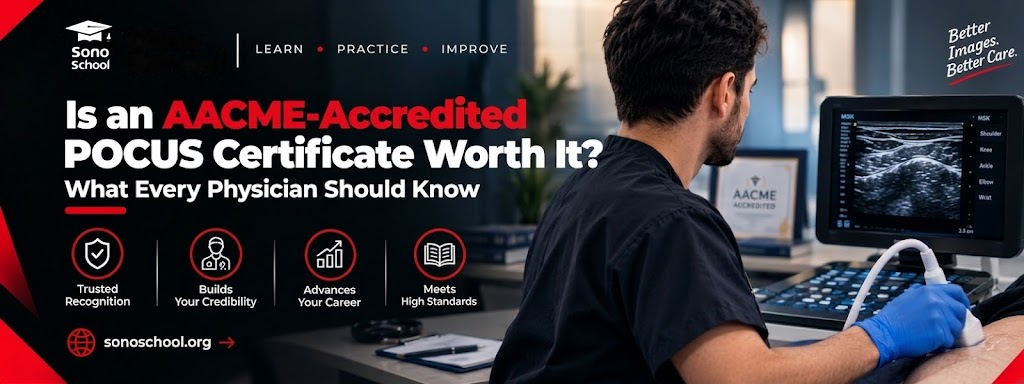
Point-of-care ultrasound (POCUS) is becoming an increasingly valuable clinical skill for physicians working in emergency medicine, critical care, anesthesiology, and other acute care specialties. It allows clinicians to obtain real-time ultrasound images at the bedside and integrate their findings into clinical assessment and decision-making.
As interest in ultrasound education grows, many physicians are searching for an AACME accredited POCUS certificate to strengthen their clinical knowledge, document continuing medical education (CME), and support their professional development. But is an accredited POCUS program worth the investment? What does accreditation actually mean, and how can you determine whether a certificate is relevant to your career?
The answer depends on the program’s educational quality, assessment methods, accreditation details, clinical relevance, and recognition by the institutions where you intend to work.
This guide explains what physicians should know before enrolling in an accredited POCUS training program, how to evaluate its benefits, and which questions to ask before paying course fees.
What Is an AACME-Accredited POCUS Certificate?
An AACME-accredited POCUS certificate is a credential associated with a point-of-care ultrasound educational program that identifies its accreditation through the American Association of Continuing Medical Education (AACME).
POCUS training focuses on using ultrasound at the bedside to support clinical assessment. Depending on the course, training may cover lung and pleural ultrasound, focused cardiac ultrasound, trauma assessment, image acquisition, ultrasound physics, and clinical interpretation.
However, physicians should distinguish between three important concepts:
- Course completion certificate: Documents that a participant completed the stated educational requirements.
- CME credit: Records participation in qualifying continuing medical education according to the provider’s policies.
- Clinical certification or credentialing: May involve additional assessments, practical evaluations, experience requirements, or approval by a professional body or healthcare institution.
These terms are not interchangeable. Receiving a certificate does not automatically demonstrate independent clinical competence, grant additional practice privileges, or guarantee acceptance by an employer or licensing authority.
Before enrolling, review the exact credential offered, the assessment requirements, and the organization responsible for issuing or accrediting it.
Is an AACME Accredited POCUS Certificate Worth It?
For physicians who want structured ultrasound education, an AACME accredited POCUS certificate may be worthwhile when the program provides relevant training, clearly documented CME arrangements, meaningful assessment, and practical opportunities to develop clinical skills.
Its value is not determined by the accreditation label alone. Consider the following benefits.
1. Structured Learning and Clinical Knowledge
Learning POCUS through isolated videos or occasional workshops can leave gaps in knowledge. A structured program can help physicians progress from fundamental ultrasound principles to image acquisition, interpretation, and clinical integration.
For example, a well-designed course may cover:
- Ultrasound physics, machine controls, and image optimization.
- Recognition of common artifacts and image limitations.
- Lung, cardiac, and trauma-focused ultrasound applications.
- Systematic scanning protocols.
- Case-based interpretation and clinical reasoning.
- Documentation, safety, and appropriate use of findings.
This structure is especially valuable for physicians who want to build a foundation before progressing to more advanced applications.
2. Documented Continuing Medical Education
CME activities help physicians maintain and develop professional knowledge throughout their careers. Depending on the program and applicable rules, completing a POCUS course may contribute to a physician’s documented educational activities.
SonoSchool’s POCUS Fellowship in Acute Care Settings describes a 48-week learning pathway with two 24-week modules and states that 32 CME credits are awarded per module, subject to program policy and successful completion criteria.
Physicians considering this program should confirm the current requirements, credit documentation, and applicability of those credits to their own professional obligations.
Important: CME credit acceptance varies by country, employer, licensing authority, and professional body. Do not assume that credits will automatically count toward every local renewal or credentialing requirement.
3. Career Development and Professional Confidence
POCUS skills may be relevant to physicians working in emergency departments, intensive care units, anesthesia, and hospital-based acute care.
A structured course can help you demonstrate a commitment to continuing education and provide evidence of focused training when updating your professional portfolio or discussing development goals with an employer.
However, a certificate alone does not guarantee a promotion, a new job, higher earnings, or authorization to perform every ultrasound examination. Those outcomes depend on experience, local regulations, employer policies, and demonstrated competence.
4. A Foundation for Advanced POCUS Training
Physicians who are new to ultrasound may benefit from starting with core concepts before progressing to specialized clinical applications.
For clinicians seeking a longer learning pathway, the SonoSchool POCUS Fellowship outlines foundation training followed by a specialized track in either Emergency Medicine POCUS or Critical Care POCUS.
This progression may be more suitable for physicians who want sustained learning and case-based development rather than a short introductory course.
AACME vs. ACCME: What Physicians Must Understand
One of the most important steps before purchasing an accredited POCUS course is verifying the exact accrediting organization.
AACME and ACCME are different organizations. The Accreditation Council for Continuing Medical Education (ACCME) is a separate organization responsible for accrediting organizations that provide continuing medical education for physicians within its accreditation system.
ACCME has also published a warning explaining that it is not affiliated with organizations using the names American Academy of Continuing Medical Education or American Association of CME (AACME).
You can read the official ACCME warning about AACME and review how ACCME accreditation works.
This distinction does not, by itself, establish whether a particular AACME-related course is good or bad. It means that physicians should avoid assuming that AACME recognition is equivalent to ACCME accreditation.
Before paying for an AACME accredited POCUS certificate, verify:
- The full legal name of the accrediting organization.
- The exact program or activity covered by the accreditation.
- The validity period and relevant accreditation documentation.
- The number of CME credits and the conditions for receiving them.
- Whether your employer, licensing authority, or professional organization accepts the credential or credits.
If you need the certificate for a specific employment, licensing, or promotion requirement, ask the relevant authority for confirmation before registering.
How to Choose the Best Accredited POCUS Course
Comparing courses based only on price, duration, or the word “accredited” can lead to the wrong decision. Use the following checklist when evaluating a POCUS training program.
| Evaluation factor | What to check before enrolling |
| Accreditation | Exact accrediting body, current status, and scope |
| Curriculum | Ultrasound topics relevant to your specialty |
| Faculty | Clinical experience and teaching qualifications |
| Practical training | Supervised scanning, image review, or practical assessment where appropriate |
| Assessment | Quizzes, case discussions, image interpretation, or competency-based evaluation |
| CME credits | Number of credits, eligibility, and completion conditions |
| Schedule | Live sessions, recorded materials, and time commitment |
| Certificate | Exact title, issuer, and requirements for completion |
| Recognition | Acceptance by your intended employer or relevant authority |
| Total cost | Tuition, additional fees, travel, and any required equipment |
Choose a Course That Matches Your Specialty
The right course should address the clinical situations you encounter regularly.
Emergency medicine physicians may prioritize trauma-focused ultrasound, lung ultrasound, rapid cardiac assessment, and emergency scanning workflows.
Critical care physicians may need more advanced training in focused echocardiography, hemodynamic assessment, shock evaluation, and multi-organ ultrasound.
Anesthesiologists may seek ultrasound education relevant to their clinical responsibilities, including appropriate procedural applications.
Internal medicine physicians may benefit from selected applications that support bedside assessment and complement other diagnostic information.
If you are unsure where to start, explore SonoSchool’s courses and workshops or contact the team to discuss your specialty and learning goals.
How Much Does an AACME-Accredited POCUS Certificate Cost?
The total cost varies by course format, duration, faculty involvement, assessment requirements, and the amount of practical training included.
A short introductory course may require a smaller investment than a longitudinal fellowship with recurring teaching sessions, case discussions, and structured assessments. However, a higher price does not automatically mean better training.
When comparing POCUS course fees, consider the total educational value rather than tuition alone. Ask whether the fee includes live teaching, recorded lectures, learning materials, assessments, CME documentation, and access to faculty or course support.
You should also ask about cancellation policies, payment terms, upcoming enrollment dates, and any additional costs.
For current program information, visit the SonoSchool POCUS Fellowship page or contact SonoSchool to request the latest fees, eligibility criteria, and enrollment details.
Is an Online POCUS Certificate Enough?
Online learning can be effective for understanding ultrasound physics, reviewing scanning protocols, studying clinical cases, and learning how to interpret images. It can also offer flexibility for physicians with demanding clinical schedules.
However, understanding ultrasound theory is not the same as demonstrating practical scanning ability.
When selecting an online POCUS course, check whether it includes image review, case-based exercises, feedback, practical assessments, or a pathway to supervised hands-on training. If the program is primarily theoretical, you may need additional supervised scanning to develop and evaluate your practical skills.
The appropriate combination of online education and hands-on training depends on your current experience, clinical responsibilities, and the competency requirements of your workplace.
POCUS findings must also be interpreted within the wider clinical picture. Ultrasound has limitations, and a certificate should never be treated as a substitute for appropriate clinical judgment, supervision, or further diagnostic evaluation when indicated.
How to Enroll in a POCUS Training Program
If you decide that a structured POCUS course fits your goals, take these steps before completing registration.
- Define your objective. Decide whether you need foundational ultrasound knowledge, specialty-focused development, CME credits, or training for a particular workplace requirement.
- Compare suitable programs. Review the curriculum, teaching format, faculty, assessment methods, and course duration.
- Verify accreditation. Request documentation and confirm the exact organization and scope of recognition.
- Confirm eligibility and credit requirements. Ask what you must complete to receive the certificate and any stated CME credits.
- Check the total cost. Request current tuition, payment details, and any additional fees.
- Register through the official provider. Keep your enrollment confirmation, course documentation, and certificate records.
To explore a structured pathway for acute care clinicians, visit the SonoSchool POCUS Fellowship and submit an inquiry for current enrollment information.
Frequently Asked Questions
1. What is an AACME accredited POCUS certificate?
It is a certificate associated with a point-of-care ultrasound educational program that identifies AACME as its accrediting organization. Physicians should verify the exact organization, program coverage, certificate requirements, and CME arrangements before enrolling.
2. Is an AACME-accredited POCUS certificate worth it?
It can be worthwhile if the curriculum matches your specialty, the teaching is clinically relevant, the assessments support learning, and the certificate or CME credits meet your professional goals. Accreditation alone does not guarantee career advancement or clinical privileges.
3. Is AACME the same as ACCME?
No. AACME and ACCME are different organizations. ACCME has published a formal warning that it is not affiliated with organizations using the names American Academy of Continuing Medical Education or American Association of CME. Always verify the specific accrediting body.
4. Does a POCUS certificate allow me to practice independently?
Not automatically. Independent practice, clinical privileges, and permitted ultrasound applications depend on your professional scope, demonstrated competence, local regulations, and institutional policies. A course certificate should not be treated as automatic authorization.
5. Can I earn CME credits through a POCUS course?
Some programs offer CME credits, but the number awarded and the requirements for earning them vary. Confirm the provider’s written policy and check whether the credits are accepted by your licensing authority or employer.
6. Is online POCUS training suitable for beginners?
Online education can provide a useful foundation in ultrasound principles, image interpretation, and clinical applications. Beginners should also consider how they will develop practical scanning skills through supervised practice, image feedback, or appropriate hands-on training.
7. How do I choose between a short POCUS course and a fellowship?
A short course may suit physicians who want to learn a specific application or refresh their knowledge. A longer fellowship may be more appropriate for those seeking a structured progression through foundational and advanced topics. Compare the curriculum, time commitment, assessment methods, and cost before deciding.
8. How can I apply for a POCUS course at SonoSchool?
Visit the SonoSchool POCUS Fellowship page or contact the admissions team to ask about eligibility, upcoming enrollment, fees, curriculum, and CME credit requirements.
Conclusion: Should You Invest in an AACME Accredited POCUS Certificate?
An AACME accredited POCUS certificate may be a valuable investment when it provides structured education, specialty-relevant learning, meaningful assessment, and clearly documented educational outcomes.
The best decision, however, goes beyond the certificate title. Physicians should verify the accrediting organization, confirm whether CME credits meet their needs, evaluate the quality of the curriculum, and understand the difference between course completion and demonstrated clinical competence.
If you want a structured pathway in point-of-care ultrasound for emergency medicine or critical care, explore the SonoSchool POCUS Fellowship and request the latest program details before enrolling.
Choose education that supports your real clinical needs, fits your professional goals, and helps you build ultrasound skills responsibly.
Medical education note: Course accreditation, CME eligibility, and professional recognition can change. Confirm current details with the provider and the relevant licensing or credentialing authority before making an enrollment decision.
Recommended learning path
Choose the next step based on whether you want to read more, join a workshop, or explore structured fellowship training.
Ready to build real bedside ultrasound confidence?
Join structured POCUS courses and hands-on workshops designed to move clinicians from theory to confident bedside application.