
POCUS Course for Physicians: The Complete Guide to Accredited Point-of-Care Ultrasound Training
Point-of-care ultrasound (POCUS) is an increasingly valuable clinical skill for physicians working in emergency medicine, critical care, internal medicine, anesthesiology, […]
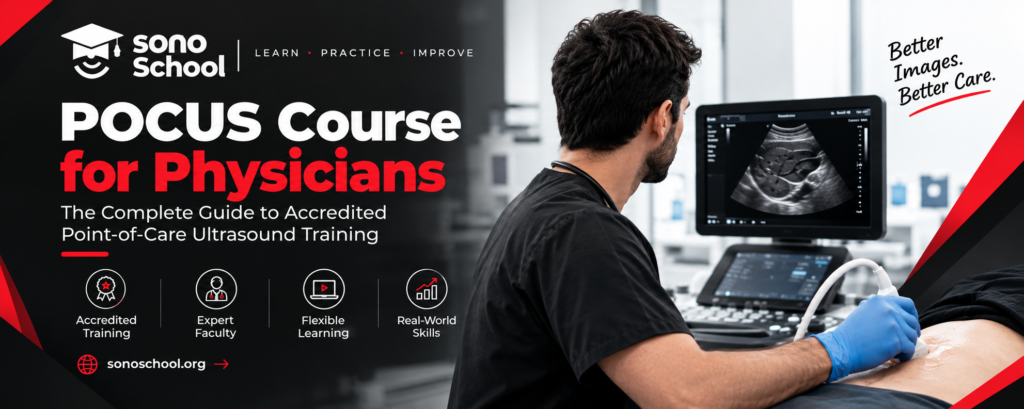
Point-of-care ultrasound (POCUS) is an increasingly valuable clinical skill for physicians working in emergency medicine, critical care, internal medicine, anesthesiology, and other acute care specialties. By bringing ultrasound directly to the bedside, clinicians can assess selected clinical questions in real time and integrate imaging findings into patient management.
However, developing reliable POCUS skills requires more than watching demonstrations or learning how to operate an ultrasound machine. Physicians need structured education, hands-on scanning practice, image interpretation skills, and an understanding of the limitations of bedside ultrasound.
Choosing the right POCUS course for physicians is therefore an important step toward developing safe, effective, and clinically relevant ultrasound skills.
In this guide, you will learn what a comprehensive POCUS training program should include, how to evaluate accreditation and certification, which training pathways to consider, and how to choose the right course for your professional goals in 2026.
What Is a POCUS Course for Physicians?
A POCUS course for physicians is a structured educational program that teaches doctors how to acquire and interpret focused ultrasound images to answer specific clinical questions.
Unlike comprehensive diagnostic imaging performed by imaging specialists, POCUS is generally integrated into the treating clinician’s bedside assessment. The physician performs a focused examination, interprets the findings in context, and determines whether additional investigations or specialist input are necessary.
Depending on the program, a point-of-care ultrasound course may cover:
- Ultrasound physics, probe selection, and machine operation.
- Image acquisition and optimization.
- Lung and pleural ultrasound.
- Focused cardiac ultrasound.
- Abdominal ultrasound and FAST examinations.
- Aorta and selected vascular assessments.
- Focused hemodynamic assessment.
- Ultrasound-guided vascular access and other procedures.
- Image interpretation, documentation, and examination limitations.
The most suitable curriculum depends on your specialty, current experience, and clinical responsibilities.
For example, emergency physicians may prioritize trauma assessment and undifferentiated shock, while critical care physicians may focus on cardiac function, respiratory failure, and integrated hemodynamic evaluation.
Explore SonoSchool’s POCUS training programs to compare available learning pathways for acute care clinicians.
Why Should Physicians Invest in POCUS Training?
A well-designed POCUS training course can help physicians develop practical skills that complement their clinical examination and other diagnostic investigations.
1. Improve Bedside Clinical Assessment
In selected situations, ultrasound can provide useful information without requiring immediate patient transfer to an imaging department.
Examples include assessing for pericardial effusion, evaluating selected lung findings, and looking for free fluid during trauma assessment.
POCUS findings must still be interpreted alongside the patient’s presentation, physical examination, and other relevant investigations. A negative focused examination does not necessarily exclude serious disease.
The American Institute of Ultrasound in Medicine (AIUM) provides an overview of POCUS applications and educational resources. <Cite refs={[“turn111265search1”]} />
2. Develop Practical Scanning Skills
Physicians need to learn how to position the probe, identify anatomical structures, optimize images, and recognize when image quality is inadequate.
A hands-on POCUS course allows participants to practice these techniques under supervision and receive feedback on their performance.
3. Strengthen Specialty-Specific Competencies
Different specialties use ultrasound for different clinical questions.
- Emergency medicine: FAST/eFAST, lung ultrasound, focused cardiac assessment, and selected shock protocols.
- Critical care: Cardiac function, lung findings, and focused hemodynamic assessment.
- Internal medicine: Selected cardiac, pulmonary, abdominal, and vascular applications.
- Anesthesiology: Ultrasound-guided procedures and selected perioperative applications.
Choosing a course aligned with your daily clinical work can make training more relevant and easier to apply in practice.
What Should an Accredited POCUS Course Include?
When comparing accredited POCUS courses, evaluate the curriculum, practical experience, instructors, assessment methods, and the exact meaning of any accreditation claim.
1. A Structured Curriculum
A comprehensive program should have clear learning objectives and progress logically from basic ultrasound principles to clinical applications.
Beginners should understand probe orientation, ultrasound physics, image optimization, and basic anatomy before moving into more complex examinations.
2. Supervised Hands-On Training
Practical scanning is essential. Look for a program that provides access to ultrasound equipment, appropriate volunteers or phantoms, and direct instructor feedback.
Before enrolling, ask how much time is dedicated to practical sessions and whether participants are assessed on image acquisition and interpretation.
3. Experienced Faculty
Instructors should have relevant clinical expertise and experience teaching ultrasound.
Good teaching covers more than obtaining a clear image. It also explains common scanning errors, limitations of interpretation, and how findings should influence the next clinical step.
4. Assessment and Feedback
A strong program should explain how learning outcomes are evaluated. Assessment may include practical scanning, image interpretation, case discussions, or other course-specific requirements.
Ask whether the course provides individual feedback, post-course learning resources, or opportunities to review cases.
5. Transparent Accreditation Information
A provider should clearly identify the organization responsible for accreditation, what the accreditation covers, and which requirements participants must meet.
The AIUM publishes training guidelines for physicians performing or interpreting diagnostic ultrasound, including guidance related to training, experience, credentialing, and continuing medical education. <Cite refs={[“turn111265search3″,”turn111265search11”]} />
Accreditation vs. Certification: What Is the Difference?
Before you pay for a POCUS course for physicians, make sure you understand the distinction between program accreditation, a completion certificate, CME credits, and professional certification.
| Term | What it generally means | What to check |
| Course accreditation | A program has been reviewed or recognized under a specific framework. | Accrediting organization and scope of approval. |
| CME credits | Educational credits awarded according to defined requirements. | Number of credits, eligibility, and completion criteria. |
| Completion certificate | Evidence that a participant completed a course. | Attendance and assessment requirements. |
| Professional certification | A credential awarded by a certification body after meeting its requirements. | Eligibility, examinations, renewal, and recognition. |
| Clinical credentialing | Authorization to perform specified examinations or procedures within an institution or jurisdiction. | Local regulations, hospital policy, and competency requirements. |
These terms are not interchangeable. Completing a short workshop does not automatically qualify a physician to perform every ultrasound examination independently or grant clinical privileges.
For emergency physicians, the American College of Emergency Physicians (ACEP) ultrasound resources include guidance on training, credentialing, and clinical ultrasound practice. <Cite refs={[“turn111265search6″,”turn111265search23”]} />
Best POCUS Course Options for Physicians at SonoSchool
SonoSchool offers different POCUS learning pathways for clinicians with varying levels of experience. Your best choice depends on whether you are starting from the beginning, developing advanced skills, or seeking a longer educational pathway.
1. Basic POCUS Two-Day Course: Best for Beginners
The Basic POCUS Two-Day Course is designed for clinicians who want a practical introduction to multi-system point-of-care ultrasound.
The published course information describes training in ultrasound fundamentals, selected cardiac, lung, abdominal, renal, and vascular applications, guided procedures, and clinical interpretation. Practical sessions use ultrasound machines, volunteers, models, and phantoms under supervision. <Cite refs={[“turn111265search14”]} />
Best for: Physicians who are new to POCUS and want to develop foundational scanning skills.
Before registering, confirm the next course date, location, fees, entry requirements, and certificate or CME arrangements.
2. Advanced POCUS Two-Day Course: Best for Experienced Learners
Physicians who already understand basic ultrasound techniques may prefer more advanced practical training.
SonoSchool’s Advanced POCUS Two-Day Course covers applications including focused echocardiography, advanced cardiac assessment, lung ultrasound in acute respiratory failure, vascular assessment, DVT evaluation, airway ultrasound, ocular ultrasound, and shock assessment. <Cite refs={[“turn111265search13”]} />
Best for: Physicians seeking to expand existing POCUS skills and develop experience with more complex acute care applications.
Check the required prior knowledge and compare the curriculum with the ultrasound applications used in your specialty.
3. POCUS Fellowship: Best for Long-Term Development
For physicians who want a structured learning pathway beyond a short workshop, the SonoSchool POCUS Fellowship in Acute Care Settings offers a longer educational program.
The published pathway runs for 48 weeks, combining a foundational module with a specialization in emergency medicine or critical care. The program describes live webinars, learning management system access, case discussions, and CME credits awarded according to its completion policy. Its page identifies AACME accreditation. <Cite refs={[“turn111265search8”]} />
Best for: Physicians seeking sustained learning and a structured progression toward advanced acute care POCUS skills.
Review the current curriculum, admission requirements, accreditation details, assessments, and completion criteria before applying.
To compare options or ask about enrollment, visit the SonoSchool website or contact the team.
How to Choose the Right POCUS Course for Your Career
Before registering, compare providers using the following checklist:
- Clinical relevance: Does the curriculum match your specialty and clinical responsibilities?
- Practical training: Is supervised scanning included?
- Faculty: Do instructors have relevant clinical and educational experience?
- Assessment: Are learning outcomes and practical requirements clearly defined?
- Accreditation: Can you verify the accrediting organization and the scope of approval?
- CME credits: Are credits offered, and will your institution accept them?
- Certificate: Does it document attendance, successful assessment, or a separate credential?
- Cost: Are tuition, travel, accommodation, and other expenses clear?
- Location: Is the course accessible from your location in Egypt, Saudi Arabia, the UAE, or elsewhere?
- Ongoing development: Can you continue practicing under appropriate supervision after the course?
The cheapest option is not always the best value. Practical teaching quality, relevant learning objectives, and opportunities to develop competency should also influence your decision.
How to Prepare for a POCUS Course
You can get more value from your training by preparing before the first session and continuing to practice afterward.
Before the course:
- Review basic ultrasound physics and probe orientation.
- Identify the clinical applications most relevant to your specialty.
- Check whether previous ultrasound experience is required.
- Confirm practical arrangements, assessment, and completion requirements.
During the course:
- Practice each view instead of relying only on demonstrations.
- Ask instructors for feedback on probe movement and image quality.
- Discuss common interpretation errors and inconclusive findings.
- Learn when POCUS is insufficient and additional investigation is needed.
After the course:
- Arrange supervised scanning opportunities where available.
- Review images and cases with experienced colleagues.
- Follow local documentation and quality-assurance procedures.
- Continue learning through structured practice and reputable educational resources.
The goal is not simply to complete a course. It is to develop safe, reproducible skills that can be applied appropriately in clinical practice.
Frequently Asked Questions About POCUS Courses for Physicians
1. What is the best POCUS course for physicians?
The best course depends on your specialty, experience, and learning objectives. Beginners may benefit from a basic hands-on course, experienced clinicians may prefer advanced training, and physicians seeking a longer educational pathway can consider a structured fellowship.
2. Can beginners enroll in a POCUS course?
Yes. Many introductory courses are designed for physicians with little or no previous ultrasound experience. Look for training that includes ultrasound fundamentals, probe handling, image optimization, core scanning applications, and supervised practice.
3. How long does a POCUS course take?
Duration varies by provider. Introductory and advanced workshops may run for one or two days, while fellowship programs can extend over several months. Check the total learning hours, practical sessions, and assessment requirements.
4. Is an accredited POCUS course the same as professional certification?
No. Accreditation relates to recognition of a program under a particular framework, while professional certification involves meeting a certification body’s defined requirements. A course completion certificate does not automatically equal professional certification.
5. Can I earn CME credits from POCUS training?
Some programs offer CME credits, but availability and eligibility vary. Confirm the number of credits, the awarding organization, and whether the credits satisfy your employer’s or licensing body’s requirements.
6. Which POCUS applications should physicians learn first?
Most beginners should start with ultrasound physics, probe handling, image optimization, and applications relevant to their specialty. Emergency and critical care physicians may prioritize lung ultrasound, focused cardiac assessment, FAST/eFAST, and selected shock applications.
7. Where can I register for a POCUS course in the Middle East?
SonoSchool offers basic and advanced POCUS courses alongside a longer fellowship pathway. Visit SonoSchool or contact the team to confirm current dates, locations, fees, and registration requirements.
8. Does completing a POCUS course qualify me to perform all ultrasound examinations independently?
No. Course completion alone does not establish competency in every application or grant universal clinical privileges. Physicians must follow applicable training, supervision, credentialing, and local regulatory requirements.
Conclusion: Choose the Right POCUS Training Pathway
Choosing the right POCUS course for physicians is an investment in practical clinical education. A high-quality program combines structured learning, supervised scanning, experienced faculty, meaningful assessment, and transparent accreditation information.
If you are new to ultrasound, a foundational course can help you build essential skills. If you already have experience, advanced POCUS training may help you expand your clinical applications. For longer-term development, a structured fellowship may be worth considering.
SonoSchool offers basic and advanced POCUS courses alongside a longer acute care fellowship pathway. Compare the programs with your clinical goals, verify the current course and accreditation details, and choose the training option that best fits your professional development needs.
Ready to develop your bedside ultrasound skills? Explore SonoSchool’s POCUS courses and contact the team to ask about upcoming training opportunities.
Medical education disclaimer: This article is intended for educational and course-selection purposes. POCUS should be performed and interpreted by appropriately trained clinicians in accordance with relevant professional guidance, local regulations, and institutional credentialing policies.
Recommended learning path
Choose the next step based on whether you want to read more, join a workshop, or explore structured fellowship training.
Ready to build real bedside ultrasound confidence?
Join structured POCUS courses and hands-on workshops designed to move clinicians from theory to confident bedside application.