
Basic vs. Advanced POCUS Courses: Which Level Is Right for Your Specialty?
Point-of-care ultrasound (POCUS) is becoming an essential practical skill for physicians working in emergency medicine, critical care, internal medicine, anesthesiology, […]
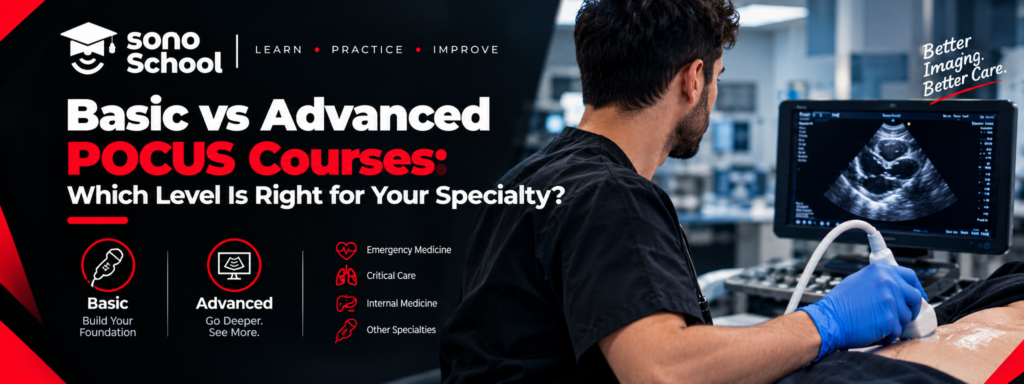
Point-of-care ultrasound (POCUS) is becoming an essential practical skill for physicians working in emergency medicine, critical care, internal medicine, anesthesiology, and other acute care specialties. It enables clinicians to perform focused ultrasound examinations at the bedside and integrate findings into clinical decision-making.
However, choosing the right training level can be challenging. Should you start with a basic course, or is an advanced POCUS course a better investment in your professional development?
The answer depends on your existing ultrasound experience, specialty, clinical responsibilities, and learning objectives. This guide compares basic and advanced POCUS training, explains which applications suit different specialties, and helps you choose the right course for your needs in 2026.
What Is the Difference Between Basic and Advanced POCUS Training?
Basic and advanced POCUS courses serve different educational purposes. A basic course establishes the foundations of ultrasound scanning, while advanced training develops more complex applications and clinical interpretation skills.
What Does a Basic POCUS Course Cover?
A basic POCUS course is designed to help physicians develop foundational skills in ultrasound physics, probe handling, image acquisition, and focused clinical assessment.
Typical topics include:
- Ultrasound physics and machine settings.
- Probe selection and image optimization.
- FAST examinations for selected trauma assessments.
- Basic cardiac ultrasound.
- Lung and pleural ultrasound.
- Abdominal and renal ultrasound.
- Aorta and inferior vena cava assessment.
- Ultrasound-guided vascular access.
- Introduction to focused clinical protocols.
The objective is to help learners understand how to obtain useful images, recognize selected findings, and appreciate the limitations of focused examinations.
SonoSchool’s Basic POCUS Two-Day Course includes multi-system ultrasound applications, supervised practical sessions, and ultrasound-guided procedures.
Best for: Physicians who are new to POCUS or need a structured foundation before progressing to more advanced applications.
What Does an Advanced POCUS Course Cover?
An advanced POCUS course builds on existing scanning knowledge. It explores more complex ultrasound applications, advanced image interpretation, and the integration of multiple findings into clinical assessment.
Depending on the curriculum, topics may include:
- Advanced focused echocardiography.
- Left and right ventricular function assessment.
- Lung ultrasound in acute respiratory failure and ARDS.
- Selected ultrasound findings associated with pulmonary embolism.
- Deep vein thrombosis assessment.
- Pericardial effusion and cardiac tamponade.
- Advanced shock assessment and RUSH protocols.
- Fluid status and hemodynamic assessment.
- Ocular and airway ultrasound.
- Complex acute and critical care scenarios.
SonoSchool’s Advanced POCUS Two-Day Course covers advanced cardiac assessment, lung ultrasound, vascular applications, ocular and airway ultrasound, and shock assessment.
Best for: Physicians who already understand basic bedside ultrasound and want to extend their practical skills.
An advanced course should not simply introduce more topics. It should help clinicians refine image acquisition, interpret findings more critically, and understand when additional imaging or specialist evaluation is needed.
Basic vs. Advanced POCUS: A Side-by-Side Comparison
Use the following table to compare the two training levels before you register.
| Feature | Basic POCUS Course | Advanced POCUS Course |
| Target learners | Beginners and clinicians building foundations | Clinicians with prior POCUS knowledge |
| Main objective | Learn core scanning techniques | Develop more complex applications |
| Ultrasound physics | Fundamentals and basic machine operation | Advanced optimization and troubleshooting |
| Cardiac ultrasound | Basic focused cardiac views | More detailed cardiac and hemodynamic assessment |
| Lung ultrasound | Core findings and common applications | Complex respiratory presentations and advanced patterns |
| Shock assessment | Introduction to selected focused protocols | More integrated, multi-organ assessment |
| Practical training | Foundational supervised scanning | Advanced supervised scanning and case-based practice |
| Preparation | Usually suitable for beginners | Basic scanning knowledge is recommended or required |
| Best next step | Supervised practice and progressive learning | Continued practice, assessment, and specialty-specific development |
Course content varies by provider, so always review the actual curriculum rather than relying on the labels basic and advanced alone.
Which POCUS Course Is Right for Your Medical Specialty?
The most suitable training level depends on the ultrasound applications you need in your clinical practice.
1. Emergency Medicine Physicians
Emergency physicians frequently need focused information when evaluating trauma, respiratory distress, chest pain, and undifferentiated shock.
A basic course can introduce FAST/eFAST, lung ultrasound, focused cardiac assessment, and selected abdominal applications.
An advanced POCUS course may be appropriate if you already perform these examinations and want to develop more complex cardiac assessment, DVT evaluation, airway ultrasound, and integrated shock protocols.
Recommended pathway: Start with basic POCUS if you are new to ultrasound. Choose advanced training when you can reliably obtain and interpret foundational views.
Explore SonoSchool’s Basic POCUS Course or Advanced POCUS Course.
2. Critical Care and ICU Physicians
Critical care physicians may use POCUS to investigate selected causes of respiratory failure, evaluate cardiac function, and support the assessment of shock.
Basic training establishes the foundations of lung ultrasound, focused echocardiography, and vascular assessment. Advanced training can help clinicians develop more complex cardiac and multi-organ scanning skills.
Recommended pathway: Basic POCUS for beginners; advanced POCUS for physicians with established foundational skills. Those seeking a longer educational pathway can also consider a structured POCUS Fellowship.
3. Internal Medicine Physicians
Internal medicine covers a wide range of presentations, including dyspnea, edema, abdominal symptoms, and suspected fluid imbalance.
Basic POCUS may help physicians develop selected cardiac, lung, abdominal, and renal scanning skills relevant to their clinical setting.
Advanced training may be valuable for clinicians who regularly use ultrasound and need more complex cardiac, vascular, or hemodynamic applications.
Recommended pathway: Choose the course based on your current skills and the examinations you expect to perform.
4. Anesthesiology Physicians
Anesthesiology involves ultrasound applications such as vascular access, regional anesthesia, and selected perioperative assessments.
Basic training can introduce probe handling, needle visualization, and relevant anatomy. Advanced or specialty-specific training may be necessary for more complex procedures and applications.
Recommended pathway: Begin with foundational training if needed, then select a course specifically aligned with your intended procedures. A general advanced POCUS course may not replace dedicated regional anesthesia training.
5. General Practice and Family Medicine
General practitioners may use focused ultrasound for selected clinical questions, depending on their practice environment, training, and local regulations.
A basic course can introduce common applications, including selected lung, abdominal, renal, and vascular assessments.
Advanced training may be useful when the physician has an established POCUS practice and a clearly defined need for additional applications.
Recommended pathway: Start with a practical foundational course and progress according to your clinical responsibilities.
Five Signs You Are Ready for an Advanced POCUS Course
Before paying for advanced ultrasound training, assess whether you have the foundations needed to benefit from it.
You may be ready if you can:
- Operate the ultrasound machine confidently. You understand basic controls, probe selection, depth, gain, and image optimization.
- Obtain core views consistently. You can acquire the required images for the basic examinations you have been trained to perform.
- Recognize common findings. You understand the main patterns taught in your foundational training and their limitations.
- Identify technical limitations. You can recognize when an image is inadequate or an examination is inconclusive.
- Connect findings to clinical questions. You understand that POCUS must be interpreted alongside the patient’s presentation and other investigations.
If several of these skills are still developing, a basic course or additional supervised practice may be a better investment than immediately enrolling in advanced training.
How to Choose the Best Advanced POCUS Course
Not every advanced ultrasound course offers the same depth or practical experience. Before you register, compare providers using these criteria.
Practical training: Confirm that the course includes supervised scanning rather than relying exclusively on lectures.
Relevant curriculum: Look for applications that match your specialty and current clinical responsibilities.
Faculty experience: Check the instructors’ clinical backgrounds and ultrasound teaching experience.
Assessment: Ask whether the program evaluates practical skills, image interpretation, and clinical reasoning.
Prerequisites: Verify whether prior POCUS experience is required.
Accreditation and CME: Confirm the accrediting organization, the scope of accreditation, and any CME credit arrangements.
Fees and availability: Request current tuition, course dates, location, and any additional costs.
For physicians comparing options, the American Institute of Ultrasound in Medicine (AIUM) publishes ultrasound training guidelines covering relevant training, experience, credentialing, and CME requirements.
Emergency physicians can also consult the American College of Emergency Physicians (ACEP) ultrasound resources for educational materials and guidance on emergency ultrasound practice.
Remember that course completion does not automatically grant independent practice privileges or qualify a physician for every ultrasound application. Competency assessment, supervised experience, institutional credentialing, and local regulations may apply.
Basic or Advanced POCUS at SonoSchool: How to Enroll
SonoSchool provides two-day basic and advanced POCUS training options, allowing physicians to select a starting point according to their existing knowledge and educational goals.
- New to ultrasound? Review the Basic POCUS Two-Day Course.
- Already familiar with core scanning? Explore the Advanced POCUS Two-Day Course.
- Looking for a longer pathway? Review the POCUS Fellowship.
Before booking, confirm the current course dates, location, fees, entry requirements, practical components, and any certificate or CME arrangements.
You can contact SonoSchool to ask which course best matches your specialty and previous ultrasound experience.
Frequently Asked Questions
1. Should I take a basic or advanced POCUS course first?
If you have little or no ultrasound experience, start with a basic course. Advanced training is generally more useful after you understand core scanning techniques and can obtain foundational views consistently.
2. Can beginners enroll in an advanced POCUS course?
Some advanced programs may have specific entry requirements. Beginners should check these carefully because advanced content often assumes prior knowledge of ultrasound physics, probe handling, and basic image interpretation.
3. How long does a basic or advanced POCUS course take?
Duration varies by provider and curriculum. SonoSchool lists both basic and advanced POCUS options as two-day courses. Confirm the current schedule and practical training hours before registering.
4. Is an advanced POCUS course better than a basic course?
Neither level is universally better. A basic course is more appropriate for building foundational skills, while an advanced course is designed to develop more complex applications. The right choice depends on your experience and learning objectives.
5. Which specialty benefits most from advanced POCUS training?
Emergency medicine and critical care physicians may benefit from advanced cardiac, lung, vascular, and shock-assessment applications. Internal medicine and anesthesiology physicians may also benefit when advanced training aligns with their clinical responsibilities.
6. Does completing an advanced POCUS course qualify me to perform all ultrasound examinations independently?
No. Course completion alone does not establish competence in every ultrasound application or grant universal clinical privileges. Follow relevant professional guidance, local regulations, and institutional credentialing requirements.
7. Where can I register for an advanced POCUS course?
You can review the SonoSchool Advanced POCUS Two-Day Course and contact the team to confirm upcoming dates, fees, prerequisites, and registration arrangements.
Conclusion: Choose the Right POCUS Training Level
Choosing between basic and advanced ultrasound training should begin with an honest assessment of your current skills and clinical goals.
A basic course helps physicians develop foundational scanning techniques, while an advanced POCUS course builds on that knowledge through more complex applications, clinical scenarios, and focused interpretation skills.
Emergency medicine and critical care physicians may prioritize advanced cardiac, lung, vascular, and shock assessment. Internal medicine, anesthesiology, and general practice physicians should choose training that reflects their specific clinical responsibilities.
SonoSchool offers basic and advanced POCUS courses alongside a longer fellowship pathway. Review the course objectives, compare the requirements, and contact the team to identify the most appropriate option.
Ready to advance your ultrasound skills? Explore SonoSchool’s POCUS courses and choose the training pathway that fits your experience and professional goals.
Educational disclaimer: This article is intended for educational and course-selection purposes. POCUS should be performed and interpreted by appropriately trained clinicians in accordance with professional guidance, local regulations, and institutional credentialing policies.
Recommended learning path
Choose the next step based on whether you want to read more, join a workshop, or explore structured fellowship training.
Ready to build real bedside ultrasound confidence?
Join structured POCUS courses and hands-on workshops designed to move clinicians from theory to confident bedside application.