
Best Emergency Ultrasound Course in the Middle East (2026 Guide for ER Doctors)
Emergency medicine physicians often need to make critical decisions within minutes. Whether evaluating a trauma patient, assessing unexplained shock, or […]
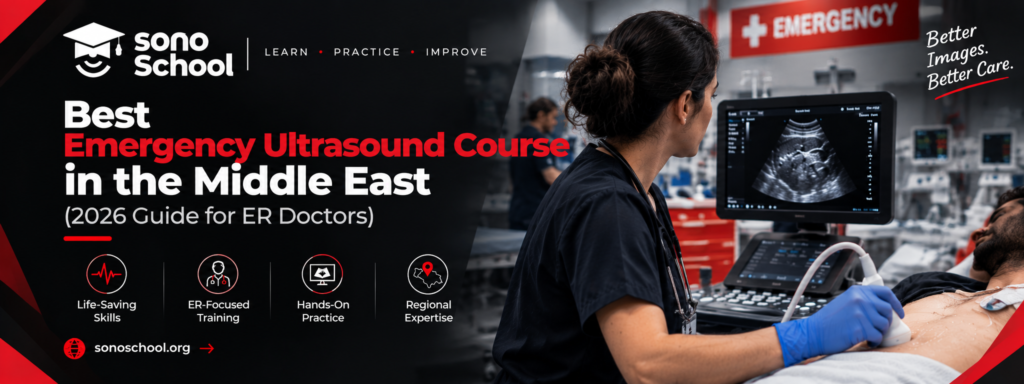
Emergency medicine physicians often need to make critical decisions within minutes. Whether evaluating a trauma patient, assessing unexplained shock, or investigating acute shortness of breath, point-of-care ultrasound (POCUS) can provide valuable bedside information without waiting for a formal imaging appointment.
However, getting the most from ultrasound requires more than knowing how to operate a machine. Physicians need structured training, supervised scanning practice, a clear understanding of ultrasound findings, and the ability to integrate those findings into clinical decision-making.
If you are searching for the best emergency ultrasound course in the Middle East in 2026, this guide explains what to look for, which skills matter most, how to compare training options, and how to choose a program that fits your clinical experience and career goals.
Why Take an Emergency Ultrasound Course in 2026?
Emergency ultrasound is increasingly important in acute care because it allows trained clinicians to investigate focused clinical questions at the bedside. It can support the initial assessment of trauma, respiratory distress, suspected fluid overload, shock, and selected cardiovascular emergencies.
The American College of Emergency Physicians (ACEP) provides guidance and educational resources for emergency ultrasound practice, while the American Institute of Ultrasound in Medicine (AIUM) offers information on POCUS applications, practice parameters, and training guidelines.
Explore the official resources:
For emergency physicians, structured ultrasound education can help develop several important competencies:
- Acquiring appropriate ultrasound views and optimizing image quality.
- Recognizing normal anatomy and common abnormal findings.
- Applying focused protocols to specific clinical questions.
- Understanding limitations and avoiding overinterpretation.
- Integrating ultrasound findings with the patient’s history, examination, and other investigations.
- Documenting examinations and recognizing when additional imaging or specialist input is needed.
Important: POCUS supports clinical assessment; it does not replace a complete examination, formal imaging when indicated, or established emergency care protocols.
What Is the Best Emergency Ultrasound Course for ER Doctors?
The best emergency ultrasound course is not necessarily the longest or most expensive program. It is the one that matches your current skill level, provides meaningful supervised practice, and teaches applications relevant to your everyday clinical work.
Before enrolling, compare courses using the following criteria.
1. A Practical, Hands-On Curriculum
Ultrasound is a practical clinical skill. Watching demonstrations and attending lectures can build theoretical knowledge, but physicians also need repeated opportunities to handle the probe, identify anatomical landmarks, acquire images, and receive feedback.
Look for an emergency ultrasound training program that includes supervised scanning using ultrasound machines, suitable models or volunteers, and realistic clinical scenarios.
Ask the provider how much time is allocated to practical sessions and whether participants receive individual feedback.
2. Training Relevant to Emergency Medicine
A useful curriculum should focus on the clinical situations emergency physicians encounter regularly.
Depending on the course level, relevant applications may include:
- FAST and eFAST: Focused assessment in trauma.
- Lung ultrasound: Assessment of lung sliding, B-lines, pleural effusions, and selected patterns associated with respiratory disease.
- Focused cardiac ultrasound: Evaluation of cardiac activity, pericardial effusion, and selected indicators of cardiac function.
- Shock assessment: Integration of cardiac, lung, abdominal, and vascular findings when clinically appropriate.
- Abdominal and renal ultrasound: Selected assessments for biliary disease, hydronephrosis, and other focused clinical questions.
- Vascular access: Ultrasound-guided procedures and needle visualization.
- DVT assessment: Appropriate venous compression techniques and recognition of findings that require further evaluation.
Advanced courses may also cover airway ultrasound, ocular ultrasound, advanced echocardiography, and more complex resuscitation scenarios.
The ideal curriculum depends on your clinical responsibilities and the competencies you are expected to develop.
3. Experienced Faculty and Useful Feedback
A good emergency ultrasound course should explain not only how to obtain an image but also how to interpret it in context.
Look for educators with relevant clinical and ultrasound teaching experience. Ask whether instructors supervise practical scanning, discuss common technical errors, and explain how to respond when images are inconclusive.
4. Clear Assessment and Completion Requirements
Before paying for a course, check what you receive upon completion.
Confirm whether the program includes practical assessment, attendance requirements, CME credits, a certificate, or post-course learning support. These features vary between providers and should be verified directly.
A course certificate does not automatically grant independent practice privileges, professional credentialing, or specialist recognition. Your institution and local regulations may impose additional requirements.
Best Emergency Ultrasound Training Options at SonoSchool
For physicians comparing emergency ultrasound courses in the Middle East, SonoSchool offers structured POCUS training designed for emergency medicine, critical care, internal medicine, anesthesia, and other acute care settings.
Its course options range from foundational hands-on training to advanced applications, allowing clinicians to select a program according to their experience.
1. Basic POCUS Two-Day Course: Best for Beginners
If you are new to bedside ultrasound or need to build a solid foundation, the Basic POCUS Two-Day Course is a relevant option to consider.
The course covers ultrasound physics, image optimization, FAST examinations, basic echocardiography, lung and airway ultrasound, renal and hepatobiliary assessment, IVC and aortic scanning, and ultrasound-guided vascular access.
Its practical components include supervised scanning using ultrasound machines, volunteers, models, and phantoms.
Best suited for: Emergency physicians who want to learn core POCUS techniques and develop a foundation before progressing to advanced applications.
Before registering, confirm the next available course date, training location, fees, and current enrollment requirements with SonoSchool.
2. Advanced POCUS Two-Day Course: Best for Physicians With Basic Experience
Physicians who already understand basic scanning techniques may benefit from more advanced training.
SonoSchool’s Advanced POCUS Two-Day Course covers focused echocardiography, advanced cardiac assessment, lung ultrasound in respiratory failure, vascular assessment, DVT evaluation, ocular ultrasound, airway ultrasound, and shock assessment.
The program also incorporates case-based learning and supervised practical sessions.
Best suited for: Emergency physicians who want to extend their existing skills and explore more complex acute care applications.
If you are comparing advanced emergency ultrasound courses, ask how the program assesses image acquisition, interpretation, and clinical integration.
3. POCUS Fellowship: Best for Structured, Long-Term Development
A short course may be a practical starting point, but some physicians want a more comprehensive learning pathway.
SonoSchool’s POCUS Fellowship in Acute Care Settings provides a structured educational pathway with foundational learning and advanced specialization in either emergency POCUS or critical care POCUS.
The emergency pathway focuses on areas such as advanced trauma and resuscitation POCUS, pediatric emergencies, acute scanning applications, and case-based decision-making.
Best suited for: Physicians seeking sustained learning beyond a short workshop and a more structured approach to developing ultrasound competencies.
A fellowship and a short course serve different purposes. Review the published curriculum, duration, assessments, accreditation details, and completion requirements before choosing a pathway.
To compare the available options, visit the SonoSchool website or contact the SonoSchool team for current course dates, locations, fees, and registration details.
How to Choose the Right Emergency Ultrasound Course in the Middle East
Emergency ultrasound training is available through different educational institutions, hospitals, professional organizations, and training providers. Rather than selecting a course based only on its title, compare the following factors.
| Selection criterion | What to verify before enrolling |
| Clinical relevance | Does the curriculum match your emergency department responsibilities? |
| Practical training | Is supervised scanning included, and how much time is allocated to it? |
| Faculty | Do instructors have relevant clinical and ultrasound teaching experience? |
| Course level | Is the program designed for beginners, intermediate learners, or advanced users? |
| Assessment | Are practical skills assessed, and how is feedback provided? |
| Certification | What certificate or CME documentation is awarded, if any? |
| Recognition | Will your employer or institution accept the course for your intended purpose? |
| Location and format | Is the course available in Egypt, Saudi Arabia, the UAE, or another accessible location? |
| Total cost | What are the tuition fees and any additional travel or accommodation expenses? |
| Ongoing support | Are case discussions, image reviews, or additional learning resources available? |
Should You Choose Training in Egypt, Saudi Arabia, or the UAE?
Your best location depends on your schedule, budget, and preferred learning format.
Physicians in Egypt may prefer a local workshop to reduce travel costs. Doctors in Saudi Arabia or the UAE may prioritize courses scheduled near their workplace or programs that fit around clinical duties.
SonoSchool lists training activities and course opportunities across
Recommended learning path
Choose the next step based on whether you want to read more, join a workshop, or explore structured fellowship training.
Ready to build real bedside ultrasound confidence?
Join structured POCUS courses and hands-on workshops designed to move clinicians from theory to confident bedside application.