
POCUS Fellowship Programs: Eligibility, Curriculum, and Career Value for Critical Care Physicians
Point-of-care ultrasound (POCUS) has become an important clinical skill for physicians working in emergency medicine, intensive care, and other acute […]
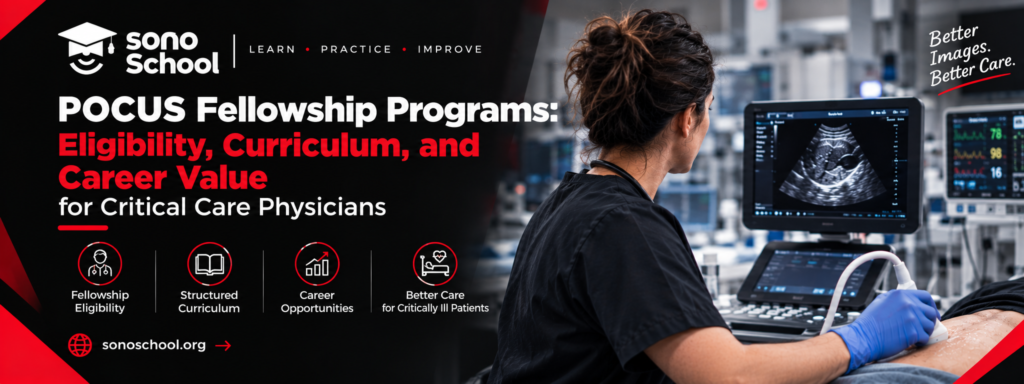
Point-of-care ultrasound (POCUS) has become an important clinical skill for physicians working in emergency medicine, intensive care, and other acute care settings. It allows clinicians to obtain real-time ultrasound images at the bedside and integrate relevant findings into patient assessment, particularly when evaluating shock, respiratory failure, and hemodynamic instability.
However, developing reliable POCUS skills requires more than attending a short workshop. Physicians need structured education, practical experience, image interpretation skills, and ongoing assessment to use ultrasound appropriately in clinical practice.
A POCUS fellowship offers a more structured pathway for clinicians who want to progress beyond introductory ultrasound training. Depending on the program, it may combine foundational ultrasound principles, specialty-specific applications, case discussions, supervised learning, and competency-based assessment.
This guide explains POCUS fellowship eligibility, curriculum structure, application considerations, and career value to help critical care physicians choose the right training program.
What Is a POCUS Fellowship?
A POCUS fellowship is a structured educational pathway designed to develop a clinician’s ability to acquire, interpret, and integrate point-of-care ultrasound findings into clinical decision-making.
Unlike a brief introductory course, a fellowship may extend over several months and provide progressive learning across multiple ultrasound applications.
Depending on the program, the curriculum may include:
- Basic ultrasound physics and machine operation.
- Lung and pleural ultrasound.
- Focused cardiac ultrasound and echocardiography.
- Abdominal and trauma-focused ultrasound.
- Hemodynamic assessment and shock evaluation.
- Image interpretation and clinical case discussions.
- Documentation, examination limitations, and appropriate clinical integration.
For critical care physicians, the primary objective is to develop a systematic approach to bedside ultrasound that supports clinical assessment without replacing comprehensive imaging when necessary.
Physicians considering a structured pathway can explore the SonoSchool POCUS Fellowship in Acute Care Settings to review its curriculum, specialization options, and application information.
Who Is Eligible for a POCUS Fellowship?
Eligibility requirements vary between educational institutions, professional organizations, and certification providers. Some programs accept clinicians with limited ultrasound experience, while others expect previous training or documented clinical practice.
1. Emergency Medicine Physicians
Emergency physicians can benefit from POCUS training when evaluating undifferentiated patients, assessing selected traumatic injuries, and supporting time-sensitive clinical decisions.
Relevant training areas may include eFAST, focused cardiac ultrasound, lung ultrasound, and ultrasound-guided procedures.
2. Critical Care and ICU Physicians
Intensivists often use bedside ultrasound to investigate potential causes of shock, evaluate cardiac function, assess lung findings, and support selected hemodynamic assessments.
A critical care-focused POCUS pathway may therefore be particularly relevant to physicians who routinely manage unstable patients.
3. Internal Medicine Physicians
Internal medicine physicians working in hospital settings may use POCUS to complement clinical examinations and investigate selected cardiopulmonary or abdominal findings.
4. Anesthesiologists and Other Acute Care Clinicians
Anesthesiologists and other clinicians involved in acute patient management may benefit from training that aligns with their clinical responsibilities, including cardiac assessment and ultrasound-guided procedures.
What Should You Check Before Applying?
Before you apply for a POCUS fellowship, review the following:
- Whether your professional background meets the program’s eligibility criteria.
- Whether previous ultrasound experience is required.
- Whether the program is intended for physicians or other healthcare professionals.
- Whether practical scanning sessions are included or arranged separately.
- What assessments and completion requirements apply.
- Whether any certificate or continuing medical education credits are awarded.
For example, SonoSchool’s POCUS Fellowship program identifies emergency medicine physicians, critical care physicians, internal medicine physicians, anesthesiologists, and hospital-based acute care clinicians among its intended participants. Contact the provider to confirm your eligibility before registering.
What Does a POCUS Fellowship Curriculum Include?
A well-structured POCUS fellowship should progress from foundational knowledge to specialty-specific clinical applications. The exact curriculum depends on the provider and the learner’s chosen pathway.
Module 1: Foundational POCUS Training
The foundation stage establishes the technical and clinical principles needed for further training.
Typical learning areas include:
- Ultrasound physics, probe selection, and machine optimization.
- Image orientation, common artifacts, and image quality.
- Lung and pleural ultrasound.
- Basic cardiac ultrasound.
- Focused abdominal and trauma ultrasound.
- Clinical reasoning and systematic scanning protocols.
These subjects help learners understand how to obtain useful images and recognize when an examination is inadequate or inconclusive.
Physicians who need an introductory course before pursuing more advanced training can explore the SonoSchool Basic POCUS Two Days Course.
Module 2: Advanced Specialty Training
After developing foundational skills, learners may progress to a specialization that matches their clinical practice.
For critical care physicians, advanced training may focus on:
- Echocardiography-based hemodynamic assessment.
- Left and right ventricular evaluation.
- Integrated assessment of shock.
- Fluid responsiveness and venous congestion concepts.
- Multi-organ ultrasound in critically ill patients.
- Case interpretation and clinical integration.
These applications require careful interpretation. For example, inferior vena cava measurements alone cannot reliably determine fluid responsiveness in every patient. Findings must be interpreted alongside the patient’s physiology, ventilation status, and other clinical information.
The SonoSchool POCUS Fellowship describes a 48-week pathway consisting of a 24-week common foundation followed by a 24-week specialized module. Its advanced Critical Care POCUS track focuses on hemodynamic assessment, perfusion, shock profiling, and multi-organ monitoring.
Review the official program page for the current curriculum and completion requirements before applying.
How Are POCUS Fellowship Participants Assessed?
Assessment is an important part of professional ultrasound education because theoretical knowledge alone does not demonstrate clinical competence.
Depending on the provider, assessment may include:
Knowledge assessments: Quizzes or examinations covering ultrasound principles, anatomy, protocols, and clinical interpretation.
Case-based discussions: Reviewing ultrasound findings and explaining how they relate to a patient’s clinical presentation.
Image review: Assessing image quality, anatomical identification, and interpretation.
Practical competency assessment: Demonstrating appropriate scanning techniques and the ability to obtain required views, when included in the program.
Structured learning activities: Completing assignments, attending educational sessions, and meeting module-specific requirements.
Before enrolling, ask whether assessments include observed practical scanning, how feedback is provided, and what must be completed to receive the final certificate.
It is also important to distinguish educational completion from professional credentialing. A fellowship certificate does not automatically authorize independent practice or replace local institutional credentialing requirements.
How to Choose the Best POCUS Fellowship Program
Choosing the right program requires more than comparing course titles or certificate descriptions. Physicians should evaluate the curriculum, educational support, assessment methods, and relevance to their clinical responsibilities.
1. Review the Curriculum in Detail
Look for a clear syllabus with defined learning outcomes and a logical progression from foundational concepts to advanced applications.
Critical care physicians should prioritize programs that address cardiac assessment, shock evaluation, hemodynamic concepts, and multi-organ ultrasound.
2. Check Instructor Expertise
Review the qualifications and clinical experience of the faculty. Instructors should have relevant experience in ultrasound education and the clinical applications covered by the course.
3. Evaluate Practical Learning Opportunities
A program may include online modules, live webinars, image review, practical workshops, or supervised clinical scanning. These formats are not interchangeable.
If independent scanning competence is your goal, clarify how practical skills are developed and assessed before you enroll.
4. Confirm Accreditation and Certificate Details
Check the exact accreditation status, the organization responsible for it, the conditions for awarding credits, and whether the certificate represents course completion or a separate professional certification.
For instance, SonoSchool states that its fellowship is accredited by the American Association of Continuing Medical Education (AACME) and that CME credits are awarded according to its module completion policy. Confirm the current accreditation and credit requirements directly with the provider.
5. Compare Time, Cost, and Flexibility
A longitudinal fellowship may require a greater time commitment than a short workshop, but it can offer a more structured learning experience.
Before registering, compare tuition, payment arrangements, session schedules, access to recorded material, assessment requirements, and any additional costs for practical training.
To review available options, visit the SonoSchool fellowship page or contact the admissions team for current program details.
What Is the Career Value of a POCUS Fellowship?
A structured POCUS fellowship can support professional development by helping physicians build skills that are increasingly relevant to acute care.
Improved Clinical Assessment
A stronger understanding of bedside ultrasound may help clinicians investigate selected clinical questions more systematically and integrate imaging findings into patient management.
Greater Confidence in Ultrasound Interpretation
Progressive learning, case discussions, and feedback can help physicians recognize normal anatomy, identify important abnormalities, and understand examination limitations.
Professional Development
Documented training and demonstrated competency may strengthen a physician’s professional portfolio, particularly when applying for roles involving acute care ultrasound, clinical education, or quality improvement.
Opportunities in Education and Research
Physicians with appropriate experience may pursue additional roles in ultrasound teaching, protocol development, audit, or clinical research. These opportunities depend on local requirements and demonstrated expertise rather than fellowship completion alone.
Important: A POCUS fellowship does not guarantee a promotion, higher salary, or specialist credential. Its value depends on the quality of the training, the skills acquired, local professional requirements, and how the physician applies the learning in practice.
For further information about a separate critical care POCUS certification pathway, review the POCUS Certification Academy’s Critical Care Certification. Its eligibility and assessment requirements are distinct from those of an educational fellowship.
Frequently Asked Questions About POCUS Fellowships
1. Who can apply for a POCUS fellowship?
Eligibility depends on the provider. Many programs are designed for emergency medicine physicians, intensivists, internal medicine physicians, anesthesiologists, and other acute care clinicians. Always review the specific admission criteria before applying.
2. How long does a POCUS fellowship take?
Duration varies by institution and curriculum. SonoSchool describes its POCUS Fellowship as a 48-week program with a 24-week foundation module and a 24-week specialization module. Confirm the current schedule and completion requirements with the provider.
3. Can I join a POCUS fellowship without previous ultrasound experience?
Some programs offer foundational teaching for clinicians with limited experience, while others require prior training. If you are new to ultrasound, ask whether the program starts with basic physics, probe handling, and standard scanning views.
4. Is an online POCUS fellowship enough to develop practical skills?
Online learning can support theoretical knowledge, image interpretation, and case-based reasoning. However, practical scanning competence requires appropriate hands-on experience and assessment. Ask how a program addresses these requirements before enrolling.
5. What is the difference between a POCUS fellowship and a POCUS certification?
A fellowship is generally a structured educational pathway, often with progressive modules and ongoing learning activities. Certification is a formal recognition awarded under a specific organization’s criteria. Requirements, assessments, and professional recognition vary between providers.
6. Does a POCUS fellowship improve career opportunities?
It may strengthen your clinical skill set and professional portfolio, particularly if your role involves acute care ultrasound. Career outcomes depend on clinical competence, experience, local credentialing requirements, and employer expectations.
7. Where can I find a POCUS fellowship for critical care physicians?
You can review the SonoSchool POCUS Fellowship in Acute Care Settings for information about its foundational curriculum, critical care specialization, learning format, and application process. Contact the provider to confirm upcoming intakes, eligibility, fees, and certification details.
Start Your POCUS Fellowship Journey
A POCUS fellowship can provide a structured pathway for physicians who want to develop bedside ultrasound knowledge and apply it more effectively in acute care. The most valuable programs combine a clear curriculum, relevant specialty training, meaningful assessment, and opportunities to strengthen practical skills.
For critical care physicians, the right educational pathway should align with everyday clinical needs, from basic cardiac assessment to more advanced hemodynamic interpretation and multi-organ ultrasound.
If you are ready to advance your ultrasound education, explore the SonoSchool POCUS Fellowship, review the curriculum and eligibility requirements, and contact the team to discuss the next steps.
Choose a program based on educational quality and clinical relevance, and continue developing your skills through supervised practice, feedback, and competency-based assessment.
Recommended learning path
Choose the next step based on whether you want to read more, join a workshop, or explore structured fellowship training.
Ready to build real bedside ultrasound confidence?
Join structured POCUS courses and hands-on workshops designed to move clinicians from theory to confident bedside application.