
One Day POCUS Course
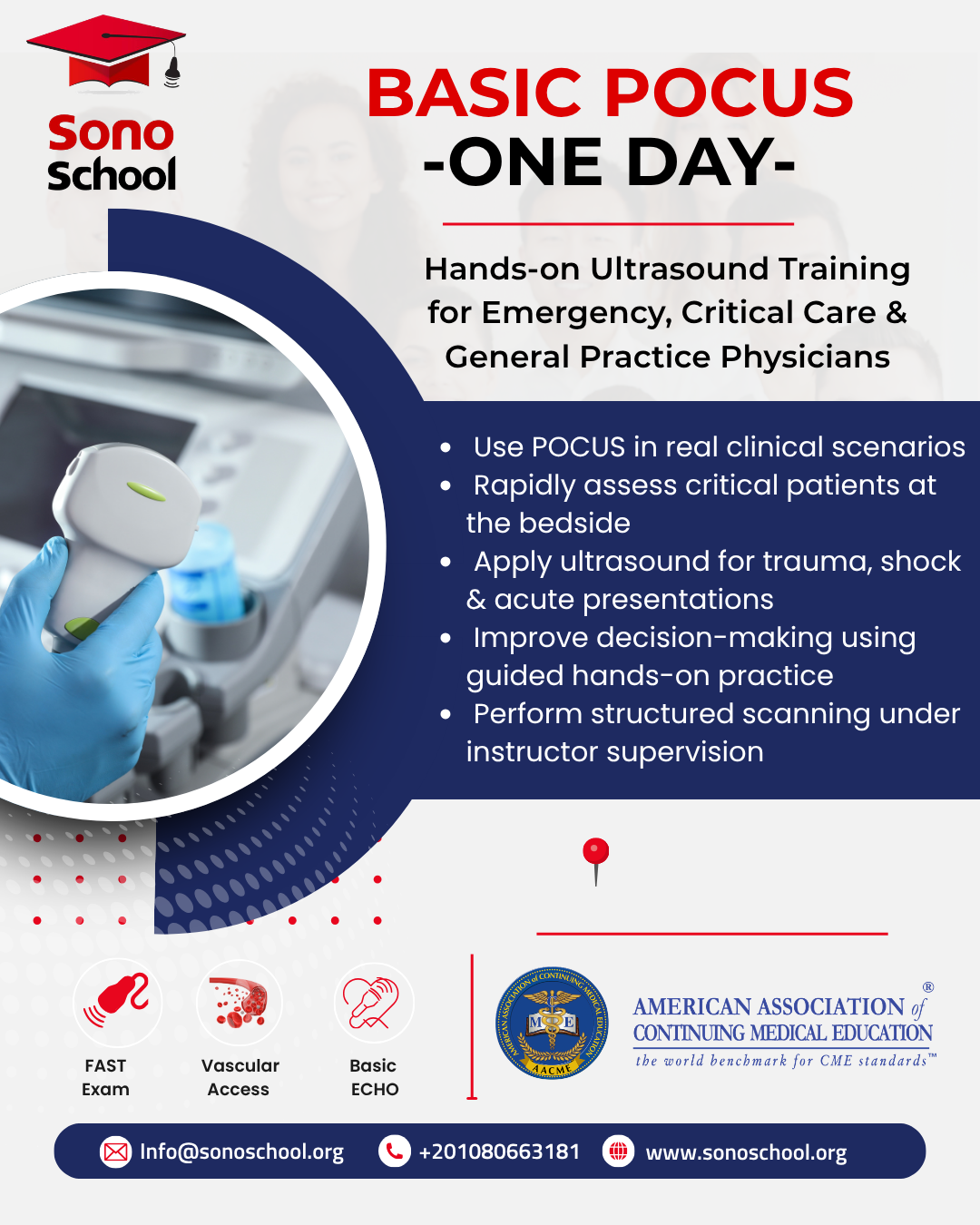
Hands-on Ultrasound Training for Emergency, Critical Care & General Practice Physicians
This intensive one-day training introduces clinicians to Point-of-Care Ultrasound for rapid diagnosis and clinical decision-making in emergency and critical care settings.
Course Overview
This intensive one-day training introduces clinicians to Point-of-Care Ultrasound (POCUS) for rapid diagnosis and clinical decision-making in emergency and critical care settings.
Through a combination of interactive lectures and hands-on scanning sessions, participants gain practical skills to perform common ultrasound procedures safely and confidently.
All sessions include live scanning using ultrasound machines, phantoms, and real volunteers under expert supervision.
Designed for clinicians at the beginning of their POCUS journey, this course focuses on building a structured foundation before moving into advanced ultrasound applications. Participants will learn how to approach the patient at the bedside, select the appropriate probe, optimize image quality, recognize common pitfalls, and connect ultrasound findings with clinical decision-making.
The training is especially relevant for physicians working in emergency departments, intensive care units, acute care settings, outpatient clinics, and general practice environments where rapid bedside assessment can support timely diagnosis and safer procedures.
Who Should Attend?
Emergency medicine physicians, critical care physicians, internal medicine physicians, general practice physicians, residents, and clinicians beginning their POCUS journey.
Course Topics
1. Physics and Knobology
- Understand ultrasound principles including frequency, wavelength, resolution, and penetration.
- Learn about various transducer types, probe orientation, and manipulation.
- Recognize common artifacts and their clinical importance.
2. FAST Examination
- Introduction to the FAST examination and its clinical indications.
- Learn the main anatomical sites: subcostal, hepatorenal, splenorenal, and suprapubic areas.
- Master scanning tips, Trendelenburg positioning, and interpretation of positive and negative findings.
3. Vascular Access
- Indications and technique for ultrasound-guided vascular access.
- Learn needle visualization, tip tracking, and safety pearls.
- Review arterial and venous anatomy.
4. Basic ECHO
- Understand cardiac probe positions and acoustic windows.
- Learn parasternal long/short axis and apical 4-chamber views.
- Master visual “eyeballing” for cardiac function and effusion assessment.
5. IVC & Aorta Evaluation
- Assess IVC collapsibility and estimate volume status.
- Use color Doppler to confirm venous and aortic flow.
- Identify aneurysms, thrombus, and key aortic landmarks.
Hands-On Ultrasound Training
This course is designed around supervised practical scanning, expert guidance, and clinically relevant ultrasound application to help participants build confidence in real bedside practice.
Ready to advance your ultrasound practice?
Book your course inquiry and the Sono School team will contact you with the details.